
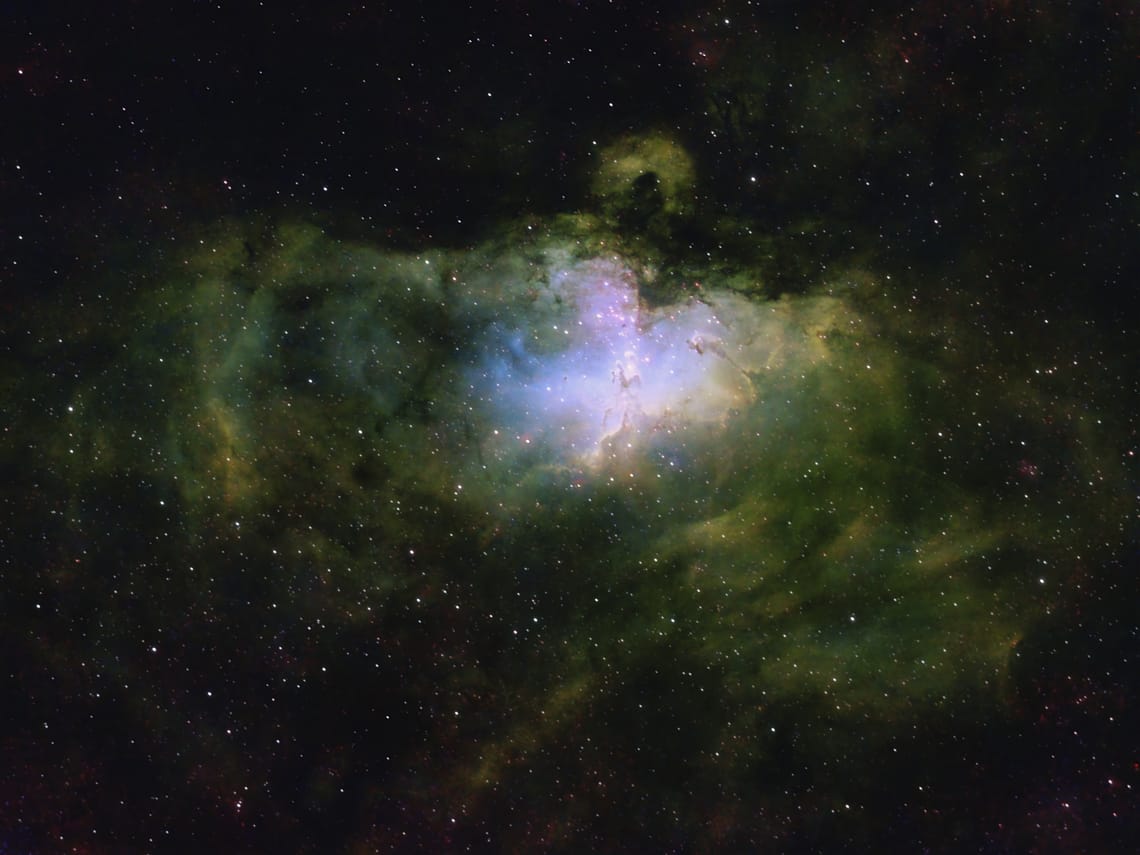
space eagle
Inspired by the colorful and bright Orion nebula, I looked for better ways to see other pretty gas clouds in the sky.
There was a problem though: cameras for taking photos on the ground (let's say: "terrestrial" cameras) usually have filters. The silicon pixels are sensitive to more wave lengths than the human eye. Normally invisible infrared or ultraviolet could appear and completely change the colors if there wasn't a UV-IR-cut filter. Usually directly on top of the sensor. Unfortunately, the brightest parts of the nebula I wanted to see are emissions from excited hydrogen, the hydrogen alpha line (short: Ha) at 656 nm. This is barely within human vision which cuts off quickly past 700 nm and usually already filtered out a bit by the UV-IR-cut.
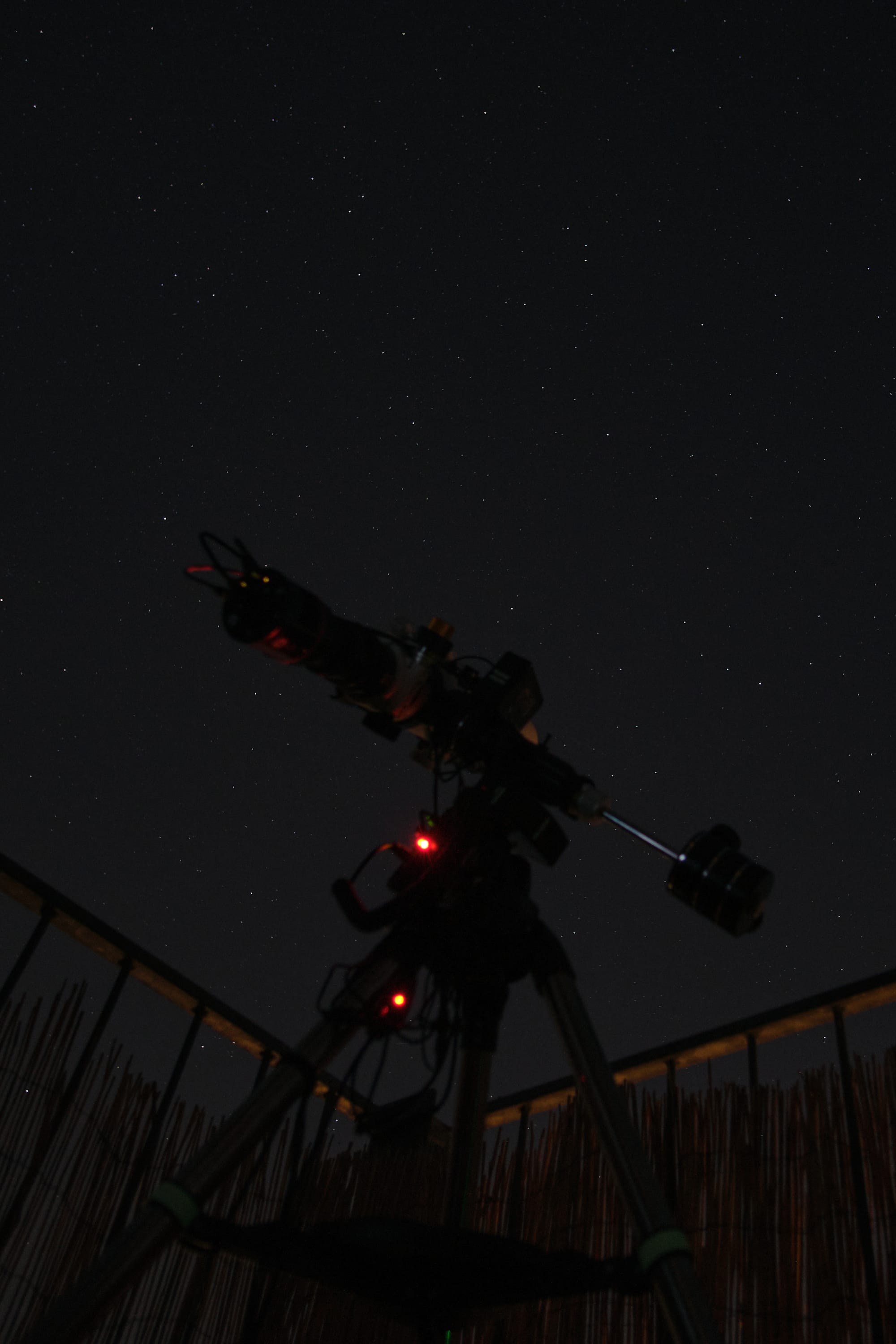
So, I got an extra camera. An astronomical camera. I also got a telescope. Ironically of very similar size as the telescope lens at 80 mm aperture (diameter in front). I also added some cheap narrow band filters. They allowed me to filter out the other light, that was not coming from the nebula. And in the end I would mix the three filtered wavelengths according to a famous recipe: the Sulfur 2 line becomes red, Ha becomes green and Oxygen 3 becomes blue. This is called the "Hubble Pallet" as it was first used to present data collected by the Hubble Telescope to the public.
In the center of the headline picture there's another small connection to the pioneering space telescope: The Pillars of Creation are at the bright center of the eagle nebula. A picture filling, high res capture of them was one of the first outputs of Hubble.
Because this object only appears low above the southern horizon in my area, and I moved to a different place from where view of the southern horizon is more obstructed, this will likely remain my only picture of it for the foreseeable future.
One more word on the thing holding my camera and optical tube: it's called an equatorial mount. It's responsible for turning the camera in such a way that the earth's rotation is compensated and the stars stay where they are during long term exposures.
This photography requires patience, technical knowledge, and specialized equipment and software. Some more pictures of nebula and galaxies will come up in future posts, but they will be sprinkled in with a lot more terrestrial photography.