orion
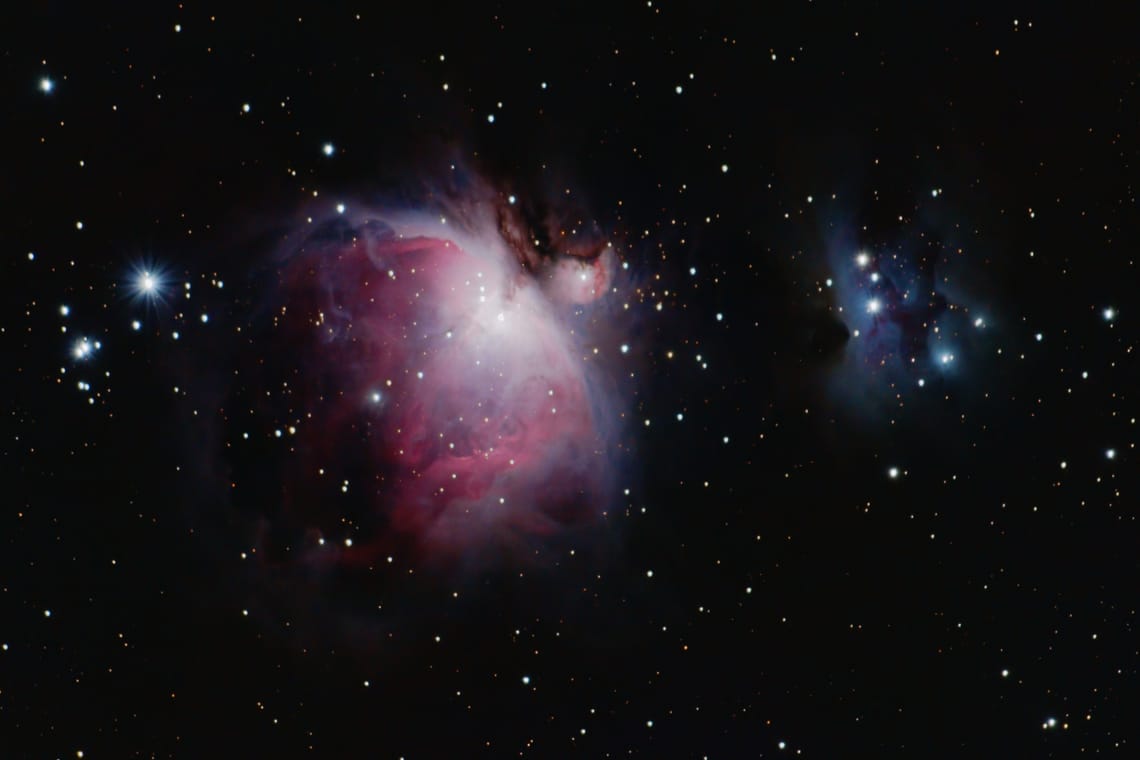
For most of my life I only new one part of one constellation: the belt of Orion marked by three bright stars close together. In early winter 2024 there were a few clear nights, and with my camera in hand I started probing the night sky: what pictures would I be able to reveal here, after what it had done for me in other situations?
Soon I turned to the weirdly familiar region close to the belt and was immediately surprised to get a glimpse of something colorful. Of course, I knew about nebulae, gas clouds far out in space. But I had never realized, that I would be able to take photos of them.
I also quickly learned that with such a long focal length, objects just drifted out of view due to earth's rotation, making long exposures impossible. After some careful consideration I got the cheapest telescope mount fit for my purpose that I could find. An equatorial mount. You point it to celestial north and it turns opposite to earths rotation to make the stars stand still in the picture.
With the long exposure problem solved (more or less), I took many pictures of about 30 s. Since the nebula is basically unchanging on scales I could resolve, I could combine all of the pictures to collect a very long effective exposure of 4410 s for this picture (just over 1 h), using a wonderful open source software called Siril.
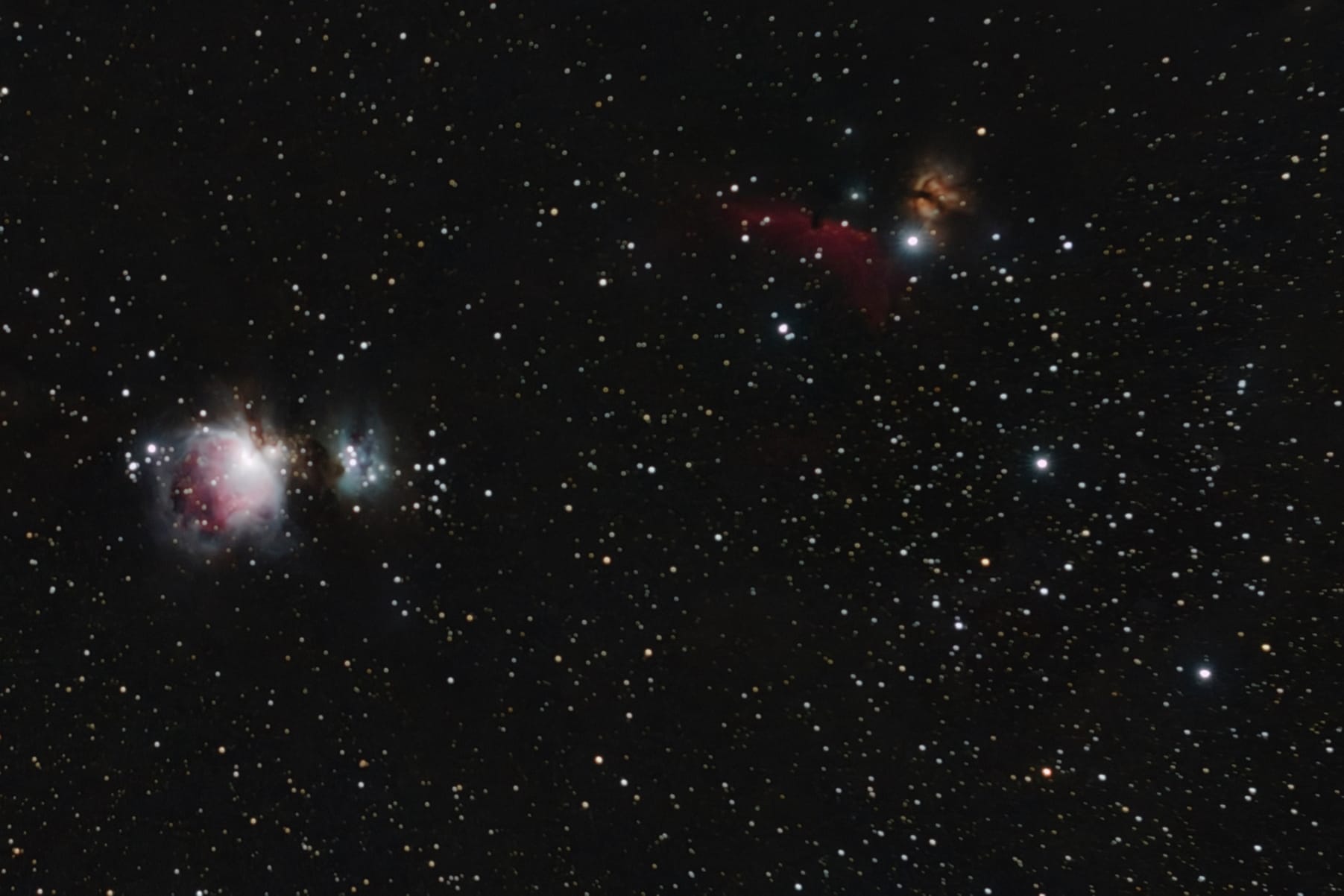
To be honest, the main picture was not my first attempt at this technique. Another is shown here with a much wider lens giving a bit of an overview.
Together, these pictures showed me the promise of making these colorful objects I had only seen on professional astronomers' displays before with my own hands (so to say). To this day, of all the objects to be photographed in space, they fascinate me the most. Many future blogs about them to come, but maybe only once in a while: this deep sky astrophotography takes a lot of time and patience.